The Techniques of Cost Analysis
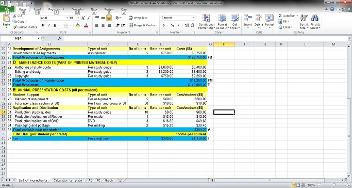
The “Techniques of Cost Analysis” was an interesting and fun module. While Excel can be very frustrating sometimes, I enjoyed working with the various formulas in the costing exercise. Further, I enjoyed learning about the different components of the costing process. As a distance education student, I could never imagine that so much work is put into developing distance education programs. I can see that it takes lots of dedication for the work and the research that is involved in determining the costs involved in setting up programs. Assignment 2, as well as the group project assignment, were useful practical exercises. The skills that were gained during these assignments are skills that can be applied in our careers as distance education specialists instantly. What is unique about the costing of distance education is that technology is always involved because it takes technology to deliver the education to the distance learners.
Technology is ever-changing; and therefore, when preparing the costs of distance education, one has to factor the costs of the upgrades that may take place during the development phase. In cost analysis, the distance education specialist must also determine the cost wisely so that an institution will see a surplus over the course of a program instead of a deficiency. The only part of the costing assignment that I could not grasp was the design of the graphs to show the “break-even” point, but this was not due to the lack of understanding of the definition of the “break-even” point, this was due to my lack of skills in using Excel consistently. I do understand that the “break-even” point is the point at which the options’ costs is equal to the proceeds that are obtained by exercising that option (Wikipedia, 2013). When there is neither a gain or a loss, that is the “break-even” point. For instance, the Rumble book uses a scenario which involves the use of delivering instruction via satellite transmission or video cassettes to demonstrate the meaning of the “break-even” point (Rumble, 1997).
While I have become familiar with the many terms of costing analysis, the break-even point stood out to me because of the trouble that I had with making it appear in my graphs despite the fact that I understand what it is. I can see where it is important for it to be clear in a costing analysis presentation.
References:
Rumble, G. (1997). The costs and economics of open and distance learning. Abingdon, Oxon: RoutledgeFalmer.
Wikipedia. (2013). Break-Even Point. Retrieved from http://en.wikipedia.org/wiki/Break-even_(economics)
